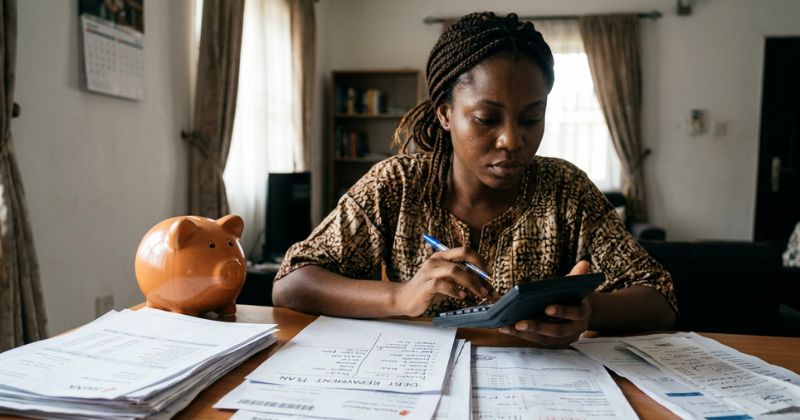
During the 2025 to 2026 financial period, debt levels among some South African consumers have surged, with individuals owing up to 28 times their monthly income, highlighting a growing gap between earnings and the true cost of living. According to the latest Consumer Report from National Debt Advisors, based on over 70,000 people under debt review, the average consumer holds R91 126 in debt while the median monthly income is only R9 536, underscoring the scale of financial pressure.
Key Takeaways
- Debt Far Outpaces Income: Many South Africans, particularly in lower-income groups, are carrying debt levels multiple times their monthly earnings, with some reaching up to 28 times their income.
- Unsecured Credit Dominates Borrowing: The vast majority of debt – especially among low-income earners – comes from high-interest unsecured sources such as personal loans, credit cards, and store accounts, increasing financial vulnerability.
- Structural Economic Pressures Persist: Slow economic growth, high unemployment, elevated interest rates, and a weaker currency continue to widen the gap between income and living costs, making debt a necessity rather than a choice.
About Arcadia Finance
Find a loan with confidence through Arcadia Finance. Compare trusted lenders, pay no application fees, and enjoy a simple process designed for your needs.
Income Versus Debt: A Growing Imbalance
Consumers earning between R5 000 and R10 000 per month are burdened with debt approaching eight times their income. Meanwhile, individuals in the higher earning bracket of R30 000 to R50 000 per month are facing debt levels exceeding 28 times their earnings.
This disparity clearly illustrates a widening disconnect between wages and the actual cost of living.
Rather than overspending irresponsibly, many South Africans are now facing a situation where their income is simply insufficient to cover essential expenses. As a result, debt has increasingly become the primary mechanism through which households attempt to bridge this financial shortfall.
Households facing similar pressure should prioritise tracking monthly expenses and identifying non-essential spending categories to prevent further reliance on high-interest debt.

Economic Conditions Continue to Limit Relief
The broader economic climate is making it increasingly difficult for consumers to regain financial stability.
Interest rate reductions have not materialised at the pace many had anticipated. With the repo rate hovering around 6.5 percent and the prime lending rate close to 10 percent, borrowing remains costly. This environment sustains financial pressure on individuals with existing obligations such as personal loans, credit cards, and home loans.
Currency depreciation is further intensifying the situation.
The South African rand has remained under strain, and a weaker currency typically drives up the cost of imported goods and services. This results in higher prices for fuel, food, and other essentials, which households feel immediately. Even though inflation indicators may suggest moderation, everyday expenses continue to rise in real terms.
A weaker currency not only increases fuel prices but also raises the cost of imported food items and electronics, indirectly affecting nearly every household expense category.
Slow Economic Growth Restricts Income Expansion
Economic growth remains subdued at approximately 1 percent, while unemployment levels are close to 32 percent. This combination limits opportunities for income growth, leaving many individuals with stagnant or non-existent wage increases.
At the same time, fiscal pressures on government finances are creating uncertainty around employment stability and wage progression, particularly within the public sector.
Nature of Debt Raises Additional Concerns
Heavy Reliance On Unsecured Credit
A significant portion of the debt carried by consumers falls into the unsecured category, which presents additional risks.
- Personal loans
- Credit cards
- Retail and store accounts
These forms of credit are typically more accessible but come with higher interest rates.
Among lower-income earners, approximately 96 percent of all debt is unsecured. Very few individuals possess assets that could offset or secure their liabilities. Only 1.4 percent of these consumers have a home loan, and fewer than 5 percent have access to vehicle financing.
This lack of asset-backed borrowing leaves individuals particularly vulnerable, as there is no collateral to fall back on. When interest rates remain elevated, repayment obligations can quickly become unmanageable.
Where possible, consolidating high-interest unsecured debt into a lower-interest facility may reduce monthly repayment pressure and total interest paid over time.

Financial Pressure Extends Beyond the Most Vulnerable
The issue of over-indebtedness is not confined solely to the lowest income groups.
More than half of individuals seeking assistance fall within the 31 to 45 age range, representing working adults in their most economically active years. Despite being employed, many within this demographic are already financially overextended.
Over-indebtedness exceeds 50 percent among lower-income groups and remains above 40 percent even among higher earners.
There is a common assumption that higher income provides financial security. However, the data suggests otherwise. Increased earnings often enable access to larger amounts of credit, which, in a challenging economic environment, can heighten financial risk rather than reduce it.
A Structural Economic Challenge Rather Than Individual Behaviour
The data strongly indicates that the issue extends beyond individual financial decision-making.
This situation reflects a structural imbalance within the economy, where income levels are not keeping pace with the real cost of living.
Rising expenses combined with the widespread availability of credit are trapping consumers in a cycle that is increasingly difficult to break. While credit may temporarily alleviate financial pressure, it does not address the underlying problem.
Instead, with persistently high interest rates, a weakening currency, and limited economic growth, the gap between income and expenses continues to widen rather than close.
Structural financial stress often requires systemic solutions such as wage growth, employment expansion, and policy adjustments – individual budgeting alone may not be sufficient to resolve the issue.
Key Figures at a Glance
| Category | Value |
|---|---|
| Average Debt | R91 126 |
| Median Monthly Income | R9 536 |
| Low-Income Debt Ratio | Up to 8x income |
| Higher-Income Debt Ratio | Over 28x income |
| Unsecured Debt (Low Income) | 96% |
| Unemployment Rate | 32% |
| Economic Growth | 1% |

Debt as a Daily Survival Mechanism
For many South African households, debt is no longer an occasional financial tool used for large purchases or emergencies. Instead, it has become an essential part of managing day-to-day living expenses.
This reality underscores the severity of the financial pressures facing consumers, where borrowing is no longer optional but necessary for survival.
Conclusion
The rising debt burden among South Africans reflects a deeper structural imbalance between income and the cost of living, rather than simply poor financial behaviour. With economic growth remaining weak, borrowing costs still high, and everyday expenses continuing to climb, many households are increasingly relying on credit just to meet basic needs. Unless there is meaningful improvement in income growth and broader economic conditions, the gap is likely to widen further, leaving more consumers trapped in a cycle of debt with limited pathways to financial recovery.
Fast, uncomplicated, and trustworthy loan comparisons
At Arcadia Finance, you can compare loan offers from multiple lenders with no obligation and free of charge. Get a clear overview of your options and choose the best deal for you.
Fill out our form today to easily compare interest rates from 19 banks and find the right loan for you.