
President Cyril Ramaphosa currently has seven pieces of legislation awaiting his signature, marking the final step before they become enforceable law in South Africa. These bills include measures that are central to government finances, public administration reform and immigration policy, and their approval is expected to carry meaningful implications for how the state operates in the coming years.
Key Takeaways
- Immigration and environmental protections are set to be strengthened: The Immigration Amendment Bill aims to align detention practices with constitutional standards, especially for children, while the Marine Oil Pollution Bill improves national preparedness and international cooperation to manage major maritime pollution incidents.
- Seven bills are awaiting final approval: President Cyril Ramaphosa has seven pieces of legislation on his desk that have already passed Parliament and now require only his signature to become law, covering areas such as public finances, immigration, public service reform and environmental protection.
- Several bills are linked directly to budget and governance reforms: Two of the pending laws deal with revenue and budget allocations, while others focus on professionalising the public service, limiting political interference and strengthening ethical and conflict of interest controls within government.
About Arcadia Finance
Apply for a loan confidently with Arcadia Finance. There are no application fees, and you can choose from 19 reputable lenders that meet National Credit Regulator requirements.
Context of Recent Legislative Signings
Earlier in the year, Ramaphosa signed the Expropriation Act into law, a decision that became one of the most contested policy developments of 2025. The Act triggered intense political debate and legal criticism within South Africa and prompted repeated public attacks on the country from the Trump Administration in the United States.
Despite the prominence of the Expropriation Act in public discourse, the president has also approved several other laws that play a crucial role in state governance. These include the General Intelligence Laws Amendment Act, the Water Resources Infrastructure Agency Act, the Eskom Debt Relief Act and the Public Sector Pension and Related Payments Act, among others. Collectively, these laws have reshaped aspects of national security oversight, infrastructure financing and public sector liabilities.
Many of these laws address long standing administrative or funding gaps rather than introducing entirely new policy directions.
As the year draws to a close, attention has shifted to the next set of legislation that has completed the parliamentary process and now awaits presidential assent.
Several of the pending bills deal with consumer protection and financial regulation. Understanding how the National Credit Act in South Africa already protects borrowers helps put these proposed laws into better perspective.
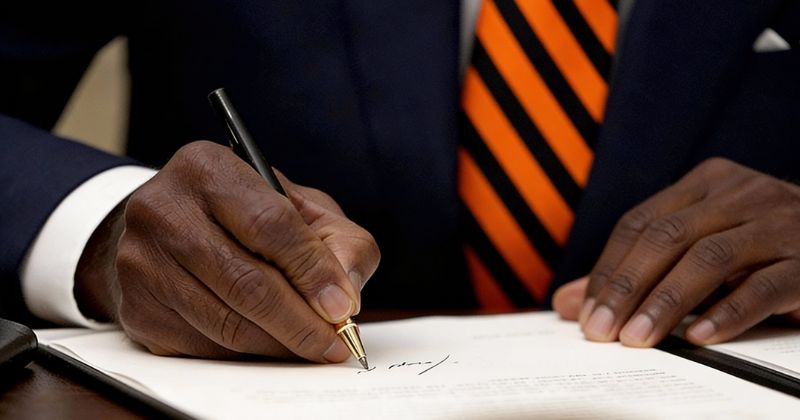
List of Bills Awaiting Signature
The seven bills currently on the president’s desk are as follows:
| Category | Bill Name |
|---|---|
| Fiscal and Budget Related Bills | Revenue Laws Amendment Bill |
| Fiscal and Budget Related Bills | Division of Revenue Amendment Bill |
| Governance and Regulatory Reform Bills | Economic Regulation of Transport Amendment Bill |
| Governance and Regulatory Reform Bills | Public Administration Management Amendment Bill |
| Governance and Regulatory Reform Bills | Public Service Amendment Bill |
| Immigration and Environmental Protection Bills | Immigration Amendment Bill |
| Immigration and Environmental Protection Bills | Marine Oil Pollution (Preparedness, Response and Cooperation) Bill |
Each of these bills has already been passed by Parliament and, where required, approved by the National Council of Provinces. Their enactment now depends solely on the president’s signature.
How Bills Become Law in South Africa
Before any bill becomes law, it must pass through a structured legislative process. Once introduced in Parliament, the bill is referred to a relevant parliamentary committee. This committee examines the proposed legislation in detail, considers submissions and may introduce amendments where necessary.
When a bill attracts substantial public interest or raises constitutional concerns, the committee can arrange public hearings to gather input from affected groups and experts. After committee deliberations are complete, the bill is debated and voted on by the National Assembly. If the bill affects provincial competencies, it must also be approved by the National Council of Provinces.
Once both Houses have passed the bill, it is sent to the president for assent. Upon being signed, it becomes an Act of Parliament and carries the full force of law.
Budget-Linked Bills Awaiting Assent
Two of the seven bills awaiting signature are primarily procedural in nature and are closely linked to the national budget process.
Revenue Laws Amendment Bill
The Revenue Laws Amendment Bill is commonly introduced alongside the national budget to refine and align existing tax and financial legislation. Its purpose is to address technical issues, clarify definitions and resolve ambiguities that may hinder effective implementation.
The 2025 version of the bill places particular emphasis on the two pot retirement system. Introduced with the second budget in March 2025, the bill progressed through parliamentary scrutiny and was approved by the National Council of Provinces in October.
While it does not introduce structural changes to the two pot system itself, it provides important clarifications and technical adjustments designed to ensure smoother administration and consistent application across retirement funds.
Retirement fund members may still notice operational changes once administrators apply the clarified rules in practice.
Division of Revenue Amendment Bill
The Division of Revenue Amendment Bill plays a central role in adjusting how nationally collected revenue is distributed between national, provincial and local governments. It is typically triggered by changes announced in the Medium Term Budget Policy Statement and is tabled at the same time.
This bill was introduced in November and approved by the National Council of Provinces before the end of the month. Its passage ensures that updated fiscal priorities and revised revenue projections are reflected in how funds are allocated across the different spheres of government.

Immigration Amendment Bill
Aligning Immigration Law With the Constitution
The Immigration Amendment Bill seeks to amend South Africa’s Immigration Act to ensure consistency with constitutional requirements. The changes aim to close legislative gaps and strengthen protections against unfair detention practices affecting immigrants.
These amendments stem from a Constitutional Court ruling issued in 2017, which found that certain provisions of the existing Immigration Act were inconsistent with the Constitution. Since then, decision making around the detention or release of undocumented immigrants has often been uneven, susceptible to abuse and prolonged by court challenges.
The proposed changes introduce clearer and more uniform rules, ensuring that immigration officers and magistrates apply the same standards when making decisions, rather than relying on broad discretionary powers.
Enhanced Protections for Children
A significant aspect of the bill concerns the treatment of child immigrants. Under the amendments, children may no longer be processed simply as illegal immigrants. Instead, they must be referred to child protection services.
Detention of child immigrants will be permitted only in exceptional circumstances and solely as a last resort, subject to court oversight. This represents a substantial shift towards a child centred and rights based approach within immigration enforcement.
Public Service and Public Administration Reform Bills
The Public Service Amendment Bill and the Public Administration Management Amendment Bill were processed together in Parliament due to their closely aligned objectives. Both aim to modernise and professionalise the public service while reducing the scope for political interference in administrative functions.
These reforms are aligned with the National Development Plan, the Professionalisation Framework and the Single Public Administration Initiative. Together, they seek to establish clearer boundaries between political leadership and administrative management.
Clarifying Roles and Ensuring Neutrality
A central objective of the bills is to delineate responsibilities between executive authorities and heads of department. Under the proposed framework, political leaders retain strategic oversight, while heads of department assume operational, administrative and financial accountability.
One of the most notable changes prohibits heads of department and their direct subordinates from holding political office within political parties. This measure is intended to reinforce political neutrality and promote professionalism within the public service.
Ethics and Conflict of Interest Controls
The bills also strengthen ethical standards and conflict of interest rules. They prohibit any public servant who serves as a director of a company, whether public, private or non profit, from conducting business with the state.
In addition, the definition of public administration is expanded to include public entities, bringing a broader range of institutions under the same governance and ethical framework.

Transport and Environmental Protection Bills
Economic Regulation of Transport Amendment Bill
The Economic Regulation of Transport Amendment Bill is largely technical in nature. Its primary purpose is to correct a clerical error in the principal Act, where Schedule 1 incorrectly refers to itself as a 2020 Act rather than a 2024 Act.
While minor, the correction is necessary to ensure legal clarity and avoid interpretative issues in the future.
Marine Oil Pollution Preparedness and Response
The Marine Oil Pollution (Preparedness, Response and Cooperation) Bill focuses on strengthening South Africa’s ability to manage major marine oil pollution incidents. It establishes national level processes for preparedness, response and coordination in the event of oil spills and related environmental hazards.
The bill also provides a framework for cooperation with other countries, including the development of contingency plans, research initiatives, training programmes and joint exercises.
Government has emphasised that South Africa’s position along a major international shipping route exposes it to heightened maritime risks, including oil spills and other forms of pollution. The bill was originally tabled in 2022, lapsed during the legislative term and was revived in 2024 before reaching the president’s desk in early December.
South Africa sits along one of the busiest shipping corridors in the southern hemisphere, increasing exposure to maritime environmental incidents.
Once signed, these seven bills will complete the legislative cycle and introduce a range of fiscal, administrative and regulatory changes that are expected to shape South Africa’s governance landscape in the period ahead.
Many of the proposed bills aim to address structural problems in the country. This comes at a time when South Africa’s economy faces serious challenges, making legislative decisions even more critical for long-term stability.
Conclusion
The seven bills awaiting President Ramaphosa’s signature represent the final phase of a legislative cycle that touches on some of South Africa’s most pressing administrative and policy priorities. From technical budget adjustments and retirement system refinements to public service professionalisation, immigration safeguards and environmental preparedness, the pending laws collectively reflect an effort to tighten governance, improve legal clarity and address long standing gaps in regulation. Once signed and implemented, these measures are expected to influence how government functions across national, provincial and local levels in the period ahead, with practical effects for public institutions, communities and the broader economy.
Fast, uncomplicated, and trustworthy loan comparisons
At Arcadia Finance, you can compare loan offers from multiple lenders with no obligation and free of charge. Get a clear overview of your options and choose the best deal for you.
Fill out our form today to easily compare interest rates from 19 banks and find the right loan for you.