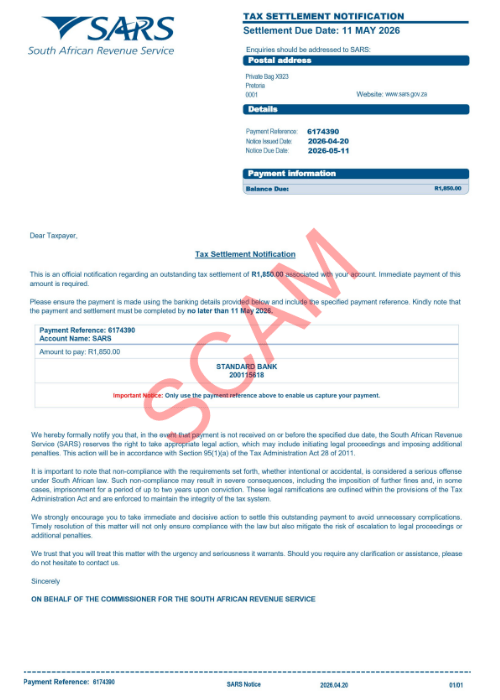
The South African Revenue Service (SARS) has officially issued a public alert regarding a newly identified scam that is currently circulating and actively targeting South African taxpayers through a fraudulent document referred to as a “Tax Settlement Notification”. This deceptive communication has been carefully designed to closely mimic the appearance and tone of legitimate, official SARS correspondence, with the deliberate intent of misleading taxpayers into transferring funds into fraudulent bank accounts in order to settle alleged outstanding tax amounts.
Key Takeaways
- Never click links or share personal details: SARS will never send payment links outside of its official domain, ask for banking details, or request credit card information – any communication doing so is fraudulent.
- Verify everything through official channels: Always check your tax status directly on the SARS eFiling website and use only your bank’s pre-registered SARS beneficiary for payments.
- Tax season is prime time for scams: With the 2026 tax season opening around mid-July, fraudsters are ramping up activity – stay alert, report suspicious emails to phishing@sars.gov.za, and act quickly if you suspect you have been compromised.
About Arcadia Finance
Get the loan you need quickly and confidently with Arcadia Finance. Compare offers from 19 trusted NCR-compliant lenders with zero application fees and a smooth, hassle-free process.
How to Identify the Fraudulent Notices
According to SARS, these fraudulent notices frequently carry titles such as “Settlement Notification” or “Final Demand”, and they typically contain embedded hyperlinks that direct unsuspecting recipients to malicious or fraudulent websites.
Fraudsters deliberately choose authoritative-sounding titles to manufacture a sense of urgency and legitimacy, exploiting the anxiety that taxpayers naturally feel around compliance deadlines.
SARS has been clear in outlining several firm rules about how it operates – rules that taxpayers can use to immediately identify a fraudulent communication:
- SARS never includes links in SMS messages or emails other than links directing to official SARS domains
- SARS never requests banking details directly from taxpayers through any communication channel
- SARS does not accept direct deposits into personal bank accounts under any circumstances
A quick way to verify whether a link is legitimate is to hover over it before clicking – the actual destination URL will appear at the bottom of most email clients. Any URL that does not end in “sars.gov.za” should be treated as suspicious.

The Full List of Known SARS-Related Scams
The latest Tax Settlement or Final Demand Notification scam is not an isolated incident – it joins a well-documented and ever-growing catalogue of similar fraudulent schemes that have surfaced over the past several years, most of which have been specifically designed to exploit SARS’s transition towards new automated systems and digital communications platforms.
This pattern of exploitation is sometimes referred to as “trust harvesting” – criminals leverage the credibility of a well-known institution to lower the victim’s guard before extracting money or sensitive personal data.
The full list of known scam types that have been identified and reported by SARS includes:
- Threats of SARS issuing court summonses against taxpayers
- Threats of SARS blacklisting taxpayers
- Threats of SARS issuing stop orders on accounts
- Notices claiming there are outstanding amounts owed to taxpayers
- Notices claiming there are outstanding amounts owed to SARS
- Notices of delayed payments pending a FICA review
- Alerts regarding pending or active SARS audits
- Urgent Settlement Notices
- Tax Settlement or Final Demand Notifications – the latest addition to this list
FICA, the Financial Intelligence Centre Act, is a legitimate piece of South African legislation used to combat money laundering and financial crime. Scammers frequently invoke real laws and regulatory processes to lend an air of credibility to their fraudulent messages.
Examples of these scams, including the most recent iteration, are available for public viewing on the official SARS scams page on their website. Here’s an example of a recent scam message:
How to Protect Yourself
To best safeguard themselves against these fraudulent schemes, SARS has urged taxpayers to observe the following precautions:
- Do not open or respond to emails from unknown or unverified sources
- Be wary of any email that requests personal, tax, banking, or eFiling details such as login credentials, passwords, PINs, or credit and debit card information
- Be aware that SARS will never ask for credit card details under any circumstances
- Avoid clicking on links contained within emails or opening attachments, particularly those in .htm or .html file formats
- Always verify your tax status directly through the official SARS eFiling website rather than acting on information received via email or SMS
- Make use of the pre-registered bank beneficiary on your banking app when making any payments to SARS
- Report any suspicious emails by forwarding them directly to phishing@sars.gov.za
If you have already clicked a suspicious link or provided personal information in response to one of these scams, contact your bank immediately to flag potential fraud. You should also change your eFiling password without delay and report the incident to the South African Police Service (SAPS) by calling 10111.
It is also worth noting that SARS eFiling offers two-factor authentication (2FA) as an added layer of security. Taxpayers who have not yet activated this feature are strongly encouraged to do so, as it significantly reduces the risk of unauthorised access to their tax profiles.

Tax Season 2026 Is Approaching
The timing of this warning is particularly significant, as South Africa is on the brink of entering its 2026 tax season – a period during which fraudsters historically intensify their activity, knowing that taxpayers are more likely to be expecting correspondence related to their tax affairs. SARS has not yet published the official opening dates for the 2026 tax season, but has confirmed the closing dates for each category of taxpayer.
The tax year under assessment for 2026 covers the financial year for companies ending during the 2026 calendar year, and the 12-month period ending 28 February 2026 for individual taxpayers. The tax season typically opens in mid-July each year, with a period of auto-assessments running approximately two weeks prior to the formal opening. SARS is expected to announce the full schedule of official dates in June 2026.
Tax Season 2026 Dates
| Income Taxpayer | Open | Close |
|---|---|---|
| Auto-Assessments | TBA | TBA |
| Individual | TBA | 23 October 2026 |
| Provisional | TBA | 22 January 2027 |
| Trusts | TBA | 22 January 2027 |
Provisional taxpayers are individuals or entities that earn income not subject to PAYE (Pay As You Earn) deductions – such as freelancers, business owners, or those earning rental or investment income. They are required to make two estimated tax payments during the year and file a final return by the January deadline.
Conclusion
As South Africa’s 2026 tax season draws closer, taxpayers are urged to remain vigilant against an increasingly sophisticated wave of fraudulent communications impersonating SARS. The revenue service has made its position unambiguous – it will never request banking details, send non-SARS links, or accept deposits into personal accounts, and any communication suggesting otherwise should be treated as a scam. By verifying all tax matters directly through the official SARS eFiling portal, using proper payment channels, and reporting suspicious activity to phishing@sars.gov.za, taxpayers can protect themselves from falling victim to these schemes. Awareness remains the single most powerful defence against fraud, and staying informed is not just advisable – it is essential.
Fast, uncomplicated, and trustworthy loan comparisons
At Arcadia Finance, you can compare loan offers from multiple lenders with no obligation and free of charge. Get a clear overview of your options and choose the best deal for you.
Fill out our form today to easily compare interest rates from 19 banks and find the right loan for you.