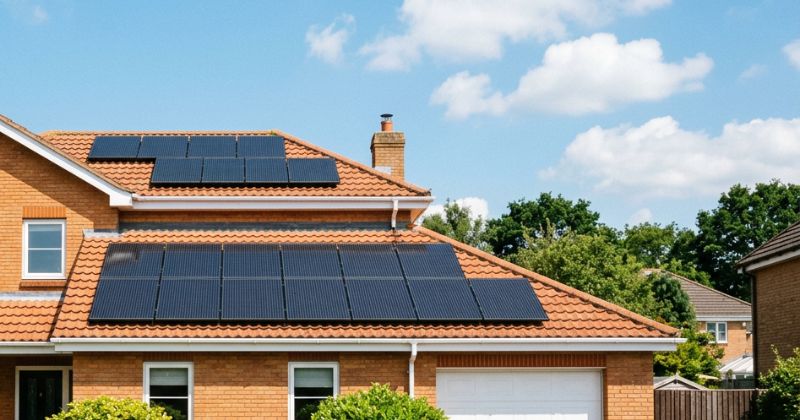
A civil rights organisation, AfriForum, has sent a formal letter of demand to the Thaba Chweu Local Municipality and the National Energy Regulator of South Africa (Nersa), regarding a newly introduced levy imposed on solar users within the municipal area, which falls within the northern part of Mpumalanga province and is seated in the town of Lydenburg, and Nersa figures show the municipality services 19,294 electricity customers in total, of whom residential households make up 53.63% of total electricity sales.
Key Takeaways
- Unlawful levy alleged: AfriForum argues the R582.64 charge for “networks available but not connected” is being unfairly applied to properties with no grid connection at all, amounting to what it calls a tax on using the sun.
- Municipality under financial strain: Nersa’s own findings show Thaba Chweu recorded energy losses of 53.16% and a deficit of -50.27%, suggesting the new charges may be more about covering financial mismanagement than recovering legitimate costs.
- Legal deadline looming: AfriForum has given Thaba Chweu and Nersa 10 days to justify the tariff process, warning it will approach the High Court for relief if no satisfactory explanation is provided.
About Arcadia Finance
Arcadia Finance makes borrowing easy. With zero application fees and a choice of 19 reputable, NCR-compliant lenders, you get a fast, hassle-free process and reliable options tailored just for you.
The New R582.64 Charge Explained
Within Nersa’s Reasons for Decision document, which relates to the municipality’s electricity tariff application for the 2026 financial year, the regulator gave the go-ahead for a new charge of R582.64 to be introduced. This charge applies to “networks that are available but not connected.”
Electricity utilities have, on numerous occasions, pointed out that they are obliged to reserve network capacity for every customer linked to the grid, regardless of whether that customer actually draws on the available power or not.
As a consequence of this obligation, fixed “capacity charges” have increasingly begun appearing on consumers’ electricity accounts.
These particular charges arise because the majority of self-generation systems that remain tied to the grid, solar installations being a common example, continue to depend on the grid as a fallback option whenever their own generating systems are offline or their battery storage has run down.
Homeowners considering solar can reduce exposure to these grid-dependency charges by investing in adequately sized battery storage and inverter systems designed to handle peak household demand without needing grid backup, though this typically comes at a significantly higher upfront cost.

Existing Charges for Small-Scale Embedded Generation (SSEG)
Separately from the new levy, Thaba Chweu already enforces basic charges applicable to small-scale embedded generation (SSEG) customers. These include the following:
- A basic monthly fee of R321.11
- An additional access charge of R10.92 per month
Both of these charges were brought into effect in July 2026.
However, it was in July that AfriForum first raised the alarm regarding the R582.64 levy, expressing concern that the charge was being applied even to properties that generate their own electricity entirely and hold no connection whatsoever to the municipal grid.
AfriForum’s Concerns Around Lawfulness
According to AfriForum, this arrangement effectively compels these households to contribute financially towards a service that they will, in practice, never make use of, a situation the organisation described as unlawful, irrational and unreasonable, going so far as to label it a tax on using the sun.
AfriForum has stated that it continues to hold the position that this levy could constitute an unlawful tax, and that no evidence has been produced to confirm that the levy followed a lawful and transparent process of public participation.
The organisation further noted that unresolved questions remain as to whether the tariffs in question are backed by a suitable cost-of-supply study, and whether the process by which they were adopted and approved met the requirements of relevant municipal and electricity legislation.
According to the organisation, it is becoming ever more apparent that municipalities under financial strain are increasingly viewing households with rooftop solar installations as a convenient means of generating extra income.
Documents Requested From the Municipality
AfriForum has indicated that it initially approached the municipal manager on 20 July, asking for documentary evidence detailing the process that was followed in adopting the tariffs. The information requested included:
- A copy of the relevant cost-of-supply study
- Copies of public notices issued regarding the tariff process
- Council resolutions relating to the tariff adoption
- Records of comments submitted by members of the public
- Documentation showing how public comments were taken into account
Under South African municipal law, particularly the Municipal Finance Management Act and Municipal Systems Act, councils are generally required to follow a public participation process before adopting new tariffs, which typically includes publishing draft tariffs for comment and holding public hearings, so a lack of documentary proof of this process can form a strong legal basis for a challenge.
Broader Pattern: AfriForum’s History With Municipal Tariffs and Nersa
AfriForum has previously pursued action against a number of municipalities, amongst them several large metropolitan cities, in relation to electricity levies and charges, and has also previously succeeded in holding Nersa accountable, most notably in matters concerning cost-of-supply studies.
Even so, the organisation maintains that this latest dispute over the solar-related charge extends beyond a simple disagreement over billed amounts.
It stated that the matter touches on a fundamental principle, namely that municipalities are only permitted to impose tariffs that are lawful, rational and have been properly approved through the correct channels.
AfriForum added that Thaba Chweu and Nersa are obliged to account for these charges, particularly in circumstances where residents who have no connection to the electricity grid at all are nonetheless expected to pay towards a service from which they derive no benefit.
AfriForum has previously acknowledged that municipalities are entitled to recover legitimate costs associated with maintaining their electricity networks, though it insists that any newly introduced charges must be lawful, transparent, reflective of actual costs, and properly sanctioned through due process.
The organisation added that residents should not be expected to serve as a financial safety net for municipalities that have failed to manage their own finances in a responsible manner.
Nersa’s Findings on Thaba Chweu’s Financial and Technical Performance
Notably, within Nersa’s own Reasons for Decision document concerning Thaba Chweu, the regulator itself pointed to a pattern of repeated technical and financial performance shortcomings, which it said have contributed to the municipality’s need to increase prices.
Among the issues identified, the regulator highlighted energy losses running as high as 53.16%, describing this as a factor that considerably weakens the municipality’s overall financial sustainability.
Financial Performance Snapshot
The municipality’s electricity division recorded an improvement in its percentage deficit, moving from -108.80% during the 2023/24 financial year to -50.27% in the 2024/25 financial year, although it remains firmly in a position of financial loss.
Bulk electricity purchases made by the municipality totalled R393.2 million, whereas the revenue generated from electricity sales amounted to only R360.2 million, leaving approximately R33 million in costs that went unrecovered.
| Financial Metric | Figure |
|---|---|
| Bulk electricity purchases | R393.2 million |
| Electricity sales revenue | R360.2 million |
| Unrecovered cost shortfall | Approximately R33 million |
| Energy losses | 53.16% |
| Deficit, 2023/24 financial year | -108.80% |
| Deficit, 2024/25 financial year | -50.27% |
| Potential net profit improvement if losses capped at 12% | Approximately R25.7 million |
| Potential deficit reduction if losses capped at 12% | From -50.27% to -4.86% |
| Potential additional revenue if losses capped at 12% | R194 million |
According to Nersa, should energy losses be restricted to a maximum of 12%, the municipality stands to improve its net profit by roughly R25.7 million, lower its deficit from -50.27% down to -4.86%, and unlock additional revenue amounting to R194 million.
Nonetheless, the regulator did point out that the municipality is currently partway through a four-year plan intended to phase in tariff increases gradually, with the aim of progressively bringing them into line with the actual cost of supplying electricity.
Consumers who believe they are being unfairly billed for network capacity charges despite being fully off-grid can typically request a formal tariff determination review from Nersa, and may also lodge a complaint directly with the municipality’s billing or revenue department, requesting a site inspection to confirm disconnection status before further charges are applied.

What Happens Next
AfriForum has now escalated the matter by issuing a formal legal letter of demand, granting the municipality and Nersa a period of 10 days within which to furnish satisfactory explanations along with supporting documentation.
Should the municipality and the regulator fail to meet this deadline, AfriForum has indicated that it intends to take the matter further by approaching the High Court in pursuit of appropriate legal relief.
Conclusion
The dispute over Thaba Chweu’s R582.64 levy highlights a growing tension between financially strained municipalities and rooftop solar users, raising questions that extend well beyond one local authority: whether tariffs are being properly justified through lawful process and cost-of-supply studies, or whether off-grid households are simply an easy target for revenue recovery. With AfriForum’s 10-day deadline now in motion and the threat of High Court action on the table, the outcome could set a precedent for how municipalities and Nersa are permitted to treat self-generating customers across South Africa going forward.
Fast, uncomplicated, and trustworthy loan comparisons
At Arcadia Finance, you can compare loan offers from multiple lenders with no obligation and free of charge. Get a clear overview of your options and choose the best deal for you.
Fill out our form today to easily compare interest rates from 19 banks and find the right loan for you.